
Bring your drawings to life with smooth, realistic shading.
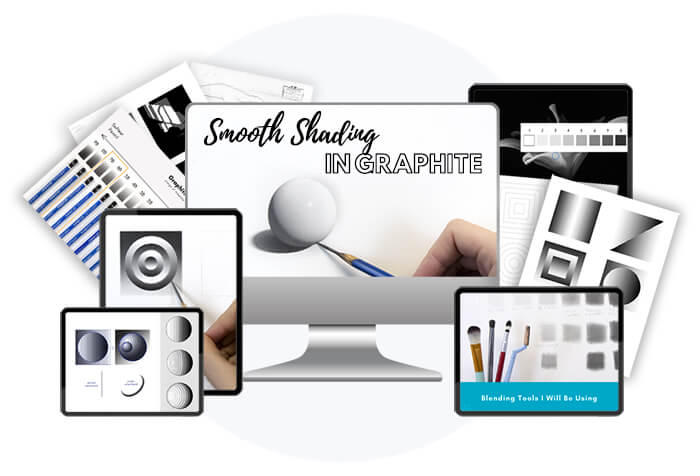
Imagine looking forward to the shading stage of your drawing.
You feel calm, focused, and confident. You reach for the ideal pencil without second-guessing. Your hand glides across the page, creating subtle transitions and lifelike depth and dimension.
You know how to create believable light and shadows, and how to smooth out uneven values.
Your drawing comes alive before your very eyes. You can almost reach into the paper and pick up the 3D object you’ve drawn.
This confident, flowing shading experience isn’t just for “naturals” or pros. It’s a skill that you can learn.
"The Techniques I Now Use in Every Drawing"

"I was attracted to this course by the exquisite, smooth, soft shading Marina achieves in her eye drawings. In contrast, my own shading was grainy, choppy, patchy, with similar edges overall, and no clear separation of dark and light values in the right places.
In this course, Marina taught me that we begin to shade by learning to see and organize values. She then introduced me to shading techniques that yield beautiful, soft, even value transitions throughout the drawing, and I use them for all of my drawings now.
I draw with new confidence having acquired these new skills.
Marina is an absolute gem of a teacher! I heartily recommend this course to anyone seeking quality art education in representational drawing."
-Tepor E., Graduate of Smooth Shading in Graphite, and the Eye Drawing Intensive
Does any of this sound familiar?
>> The Scratchy Texture Plateau: Your values look grainy or patchy no matter how softly you try to apply your pencil marks.
>> The Lighting Challenge: You don’t know how to recreate the beautiful effect of light that you see in front of you.
>> The Flat Drawing Dilemma: Your drawing doesn’t have that “I could reach right into the page” depth, and you don’t know how to create it. Your forms look cartoonish or illustrative instead of realistically 3D.
>> The Blending Tool Frustration: You’ve used blending tools to try to smooth out your shading, only to end up with smeared patches that look muddy or ruin the tooth of your paper.
You just want to reach for the right pencil with confidence, knowing how to create a flawless, glass-smooth value transition that makes an object pop off the page. That is an entirely learnable skill.
In this 6-module video course, you'll learn the essential components of smooth, realistic shading, and practice each one through targeted, focused exercises.
You'll develop the technical skills, knowledge, and modes of seeing that make smooth shading not only possible - but enjoyable.
Curriculum: Smooth Shading in Graphite
This is a skill-building course — which means we'll practice many focused exercises and drills. This is intentional: smooth, realistic shading comes from acquiring the technical skills, modes of seeing, and knowledge that make it possible. The best way to build those is through specific, targeted practice.
In this course, you won't just copy an image. You'll develop the real, transferable skills that let you shade anything smoothly and realistically — for the rest of your drawing life. And by the end — if you complete the exercises and homework — you'll have drawn a beautifully shaded sphere, and a unique shaded composition of your own — proof of how far you've come.
Module 1:
Shading Smooth, Even Values and Gradations
Build the foundation of realistic shading by learning precise pencil control and how to apply smooth, even values.
You’ll get to know graphite pencil grades, practice three essential shading techniques, and learn how to draw value scales and smooth gradations.
You’ll also discover what causes scratchy, uneven shading - and how to fix it with simple evening-out techniques.

Module 2:
Simplifying and Organizing Values
Start to see like an artist by understanding how light behaves on form.
Then, learn how to translate your heightened observation into simplified, organized values, to draw convincing effects of light.

Module 3:
Blending Tools & Drawing Nuanced Value Differences
In this module, you’ll learn how to see and draw subtle value differences to heighten the realism and believability of your drawings.
Plus, dive into blending tools: when to use them, when not to, and how to avoid the most common mistakes that lead to messy results.

Module 4:
Shading Convincing Edges for Depth and Dimension
Move beyond “flat” drawings into ones with true depth and dimension by learning to see and draw the different types of edges in your subjects.
You’ll practice specific techniques for softening, sharpening, and blending them to create a polished, three-dimensional look.

Module 5:
The Edge Design & Gradation Design Exercises
Put your knowledge of values and edges into practice with advanced shading exercises.
Then, design and beautifully shade your own unique composition — a personal piece that reflects your growing skill, confidence, and vision.

Module 6:
Drawing a Realistic Sphere
Learn the step-by-step process to 'turn form' — creating the illusion of a round, three-dimensional object by shading the elements of light and shadow convincingly.
Whether your goal is to draw the portrait or the figure, shading a sphere is an essential precursor. All complex forms are built from combinations of basic geometries like spheres, cubes, and cylinders.
To shade complex subjects convincingly, you must first know how to shade the basic forms they are made of.


By the end of this course, you'll have the foundational skills you need for smooth, realistic shading. Whether you're a beginner learning how to shade for the first time, or an intermediate artist looking to elevate your shading skills - you're in the right place.
Who You'll Learn From:
Hi! I'm Marina.
I'm a professional visual artist, arts educator, former Tenure-Track college professor of visual arts, and Founder (or 'Drawing Source'ress') of TheDrawingSource.com

In my creative practice I make 'drawing installations': large-scale drawings that transform an entire space, such as the one below. (Yes, entirely hand-drawn using charcoal on white paper!)

I wasn't born with smooth shading skills! When I was learning to draw, realistic shading was the ability I most coveted. It also seemed like the most unknowable and impossible area of drawing.
So, if smooth, believable shading seems like sorcery to you – you're not alone. It’s often perceived to be a magical ability that you're either born with or not. However:
Smooth, realistic shading is an entirely learnable skill. I would love to guide you through it.
Choose Your Learning Path
Option 1: Self-Study in the Atelier at The Drawing Source
Access the complete Smooth Shading in Graphite course immediately in the Atelier membership, and learn entirely at your own pace.
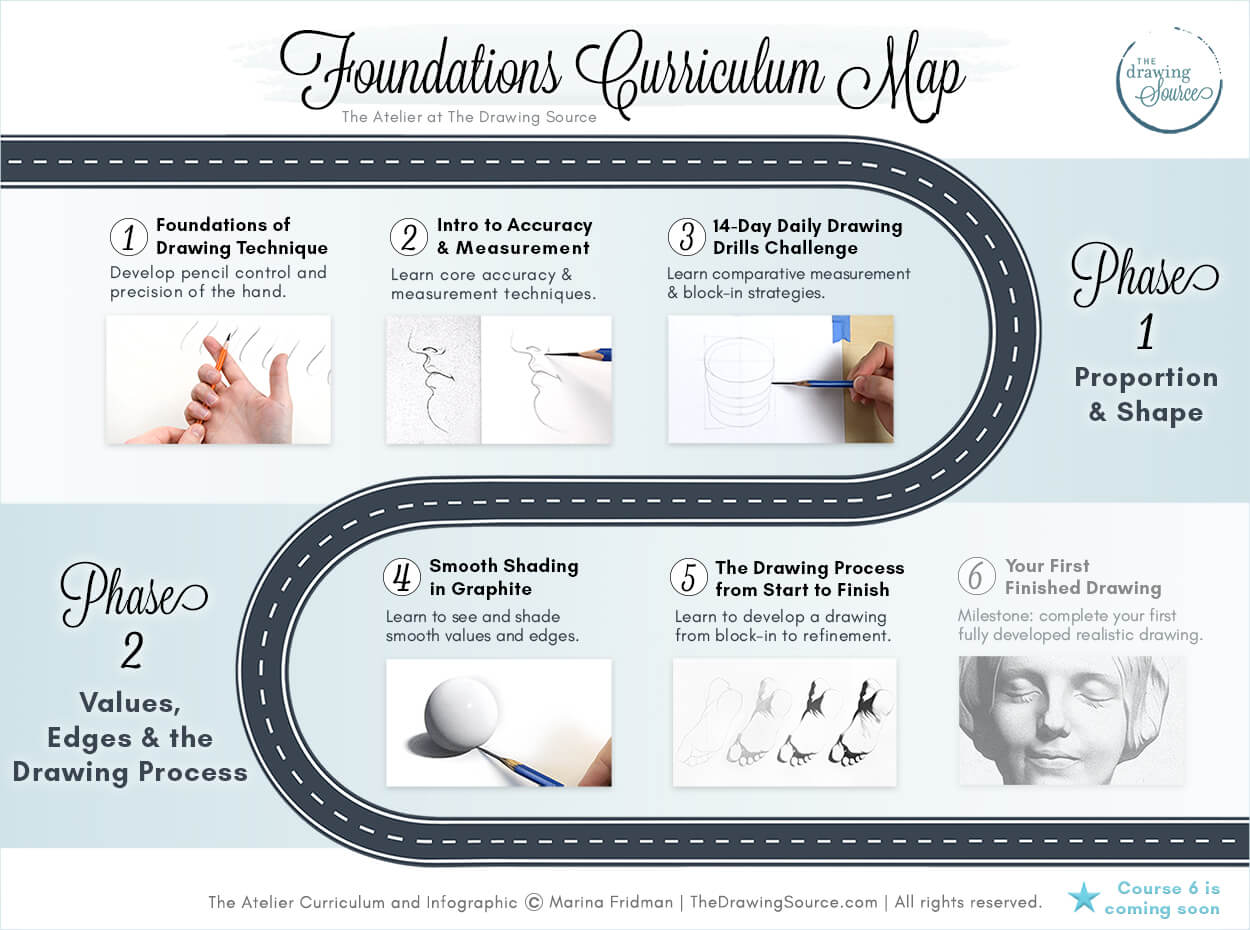
This course is part of a larger realistic drawing learning path. It’s the fourth course in a progressive curriculum designed to help you build strong foundational skills for realistic drawing — preparing you for more advanced subjects like the figure and portrait.
Access the entire Foundations Curriculum, and additional courses like Figure Drawing Quickstart and the Eye Drawing Intensive, in the Atelier.
or
Option 2: 5-Week Live Online Courses in October
Smooth Shading in Graphite or Charcoal
I’m excited to run my Smooth Shading course live online over 5 weeks this October. You are welcome to work with graphite, charcoal or both. Perfect if you’re new to charcoal and want to be guided through your first explorations.
We’ll also discuss the differences between graphite and charcoal, when to use which, and how to combine them beautifully in a single drawing.

What’s Included in the Live Online Course
>> 5 Live Online Sessions: Face-to-face training via Zoom
>> Weekly Homework Reviews: Send your assignments and questions to me each week for personalized feedback and tailored suggestions
>> Lifetime Course Access: Permanent access to the Smooth Shading course (the class replays, and the version inside the Atelier)
>> Atelier Membership Access: Access to the full Atelier membership for the duration of the 5 weeks
Choose Your 5-Week Session:
*Class sizes are limited to 6 people per group
Here is a Time Zone Converter for your convenience
(convert from EDT: Montreal or New York time)
Group 1 | Wednesday, Sept. 30 – Oct. 28 | 7 – 9pm EDT
*1 spot left!
Group 2 | Saturday, Oct. 3 – Oct. 31 | 10am – 12pm EDT